Written by Gary Blumberg
(originally published on November 25, 2025)
(Revised*) February 4, 2026
This is Part II of a previously Written and published Blog:
“You have to Know the Rules to Break the Rules Part I”
If you havent read that or need a refresher, please click on the link 👆
It will give the proper context to this piece and it was written, and intended to be read whole.
A Pioneer for the Pioneers
I continued to ‘coach’ in some capacity — through countries, careers, and seasons — sometimes as a formal role, sometimes as something more subtle working in the background. Whether on a soccer pitch, inside a law firm, or supporting players in the professional game, coaching became a thread connecting what I did with who I was becoming.
By 2003, that thread carried me to the United States. I settled with my family in Chillicothe, Ohio — not knowing it would become one of the most formative stops on this long coaching journey.
In 2004, our neighbour, Officer Larry Cox, was killed in a sudden off-duty incident behind our home. The shock ripple through the community was immediate and profound. His family, colleagues, and friends were devastated. And for us, standing so close to where it happened, the grief reshaped something internal — a quiet but significant shift in how I saw responsibility, service, and presence.
It made me say “yes” to things I may have once held at arm’s length.
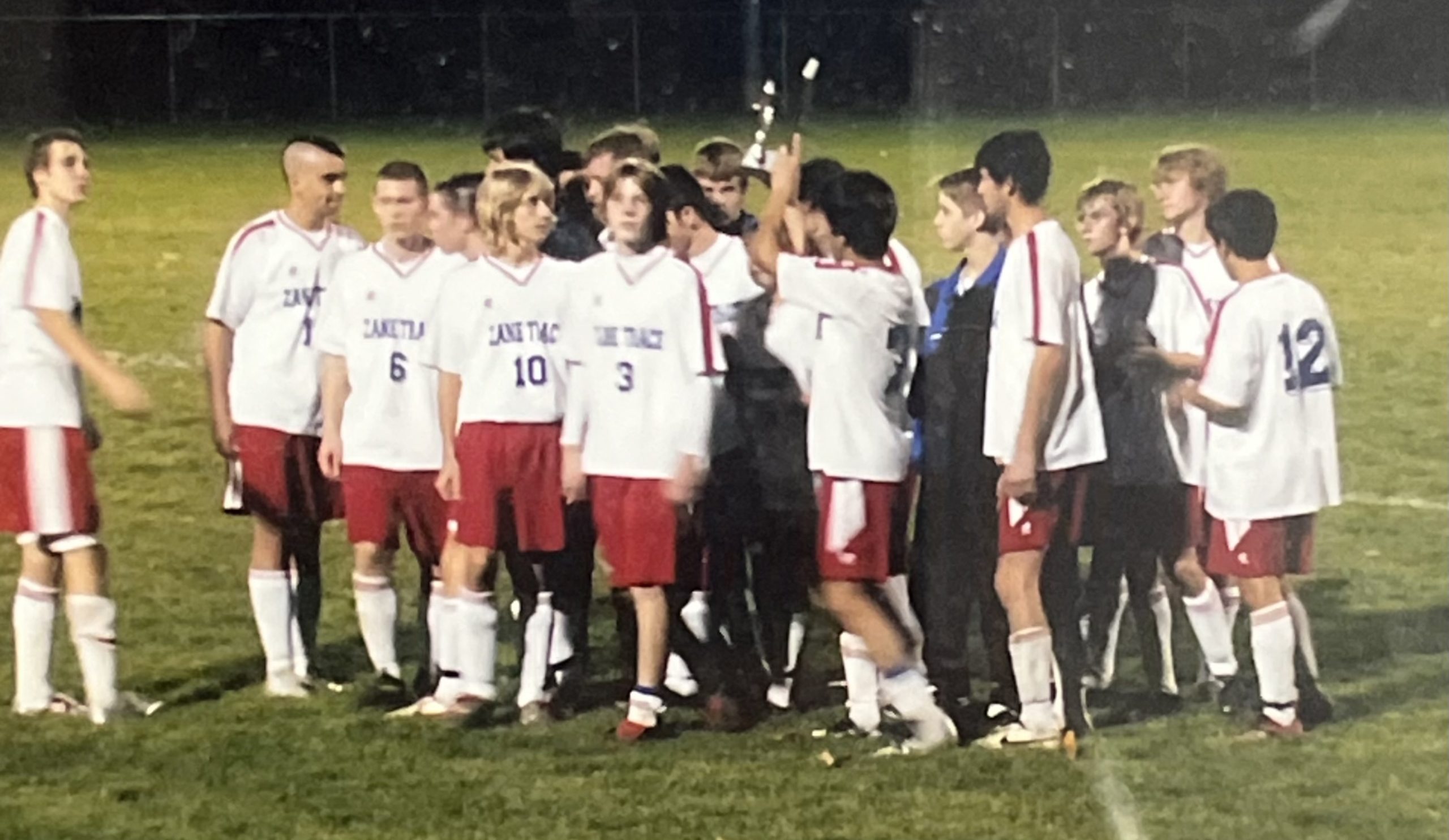
One of those moments arrived at the start of the local high school soccer pre-season, following Larry’s death. Zane Trace High School had appointed a new boys’ varsity soccer coach, but due to a serious cancer diagnosis and subsequent treatment, he was unable to take up the Head Coach’s role. The season was looming and they needed help. Larry had always said ‘yes’ to people. And his son, Evan, mourning the death of his Dad, was in the soccer squad.
Their need intersected with my readiness in a way I couldn’t ignore.

Zane Trace: A Team That Taught Me As Much As I Taught Them
I knew the game, but I was always a student of it. I knew how to teach it, but was always wondering how I could coach it better. What I definitely didn’t know was what it meant to coach high school soccer in semi-rural Ohio. The context was new. The culture was different. The expectations — from players, parents, and the school — had their own nuances.
What I discovered was a community: a small group with some talented boys hungry to grow, committed families who lived and breathed sports with sincere passion, and an assistant coach who carried humility, humour, and heart; who wanted to win just as much as I did. And he was able to help me bridge the cultural gap and provide critical local knowledge.
And that mattered. Because one of the most underrated truths in coaching is this: good coaches surround themselves with good coaches — not only because they need help – everyone does – but because it’s essential to have another perspective.
What began as a gap-filling gesture became a rich, shared experience. Everyone learned from one another. As much as I helped shape their season, they reciprocated with buy-in that helped form my understanding of what leadership, mentorship, and community could look like when thoughtfully and intentionally applied.
The Zane Trace Pioneers weren’t just a team I coached. They were a team that let me in and reminded me that if you could ignite passion for a sport, a pursuit or any endeavour, you potentially inspire an investment of full commitment that can deliver exceptional returns.

Becoming Another Kind of Coach
When we moved to Columbus in 2009, we faced another major transition, and one that would establish some roots for our family after multiple migrations and moves.
It’s funny ironic quirk of phrase that the idea of giving back is a way of paying it forward.
This experience in Chillicothe of contributing to community in an impactful way became the heart of an approach that enabled a variety of non-profit volunteer leadership roles that continue for me to this day.
In those and other roles, the ensuing years involved more coaching, mentoring, consulting, problem-solving, and advising; and crucially, continuing to learn.
Coaching an athlete or a squad carries its own kind of gravitational pull. The pursuit of performance, the shared striving, the search for the perfect moment — it hooks you. That Zane Trace journey was instructive.
But I had begun to appreciate other more subtle dimensions of coaching.
The quieter dimensions: the reflective space where identity, mindset, habits, confidence, and character live. The part of coaching that follows you off the field and into every other domain of life.
My development took a significant step forward when I joined a major national retailer and publicly listed company in a consulting capacity. Working with their innovation team on a potentially disruptive retail initiative required a blend of creativity, strategic insight, and the ability to operate within a highly structured corporate environment. Because I was embedded inside the organisation, I saw the work from multiple perspectives — the system, the people, the culture, and the pressures that shaped decision-making.
I went in with deep respect for the structure, but also the courage to challenge it when the moment called for it. That combination created a productive tension — the kind that doesn’t derail a project, but sharpens thinking and leads to better, more dynamic outcomes. I found myself drawing on all the threads of my background: the entrepreneurial instincts, the leadership experience from non-profit work, the discipline and analytical grounding of law, and the team-first mindset shaped by years in sport as both a player and a coach.
What surprised me most was not simply that I could operate inside that system, but that I could excel in it. That experience reinforced how adaptable, transferable, and uniquely valuable a coaching-led approach can be — especially in environments where innovation and accountability must coexist.
During the global pandemic, it was this quiet dimension that sharpened for me. I found myself, almost by accident, working as a ‘coach’ or ‘mentor’ to a small set of clients, mainly young adults — helping them navigate uncertainty, find clarity, improve their performance, or articulate their values and direction.
Authenticity and integrity had always been non-negotiable for me. And I had begun to realise something essential if I was going to do this seriously.
I needed more than experience, I needed grounding and rigour. A framework that honoured both science and humanity.

A Rookie in the Masters
That led me to pursue a Master of Science in Applied Positive Psychology and Coaching Psychology — a choice that deepened and formalised what had been forming in me for decades.
Suddenly, coaching had anchor points and definitions.
Passmore’s description of coaching as a future-focused, Socratic dialogue that stimulates self-awareness and personal responsibility.
Bresser and Wilson’s framing of coaching as empowering people through self-directed learning and personal growth.
Whitmore’s foundational idea that coaching is unlocking a person’s potential and helping them learn, rather than teaching them.
Those definitions didn’t replace my experience — they crystalised it.
They offered language for what I had felt intuitively across a life lived in three countries and countless settings.
Studying the research gave me structure. I was beginning to appreciate that my experience could give it some unique texture.
And my point of view, which was now combining the two, alerted me to the intangibles I had to offer. That began to give me purpose, meaning and the foundation of what it truly meant ‘to coach’.

The Rulebook, the Playbook, and the Humility Between Them
Christian van Nieuwerburgh speaks of cultivating a “coaching way of being.” That phrase resonated deeply with me.
Because coaching isn’t static. It’s perspective shifting through lenses: sometimes the microscope, sometimes the window, sometimes the aerial view.
Over the years I’ve discovered that coaching demands fluidity:
Sometimes you coach.
Sometimes you mentor.
Sometimes you advise.
Sometimes you co-create.
And, sometimes you simply hold space.
The art lies in knowing which mode belongs to the moment — and having the humility to move between them without ego, but with permission.
When clients understand what they need, coaching is clearer.
When coaches understand what they offer, coaching is better and more effective.
And that’s where the “rules” come in.
Not rules as constraints. But rules as understanding — the accumulated wisdom of those who came before you, the lessons that shape your craft, the principles that anchor your practice.
You don’t learn the rules to break them – you learn them to know when you are breaking them and when it might be helpful to the coaching process.
You learn them so that you can hopefully contribute something meaningful — your own flavour, your own way of being — while standing on the shoulders of those whose work has shaped the field.
And if or when you break them, you should ask why, and whether it was appropriate to do so.

A Way Of Being
Reflecting on this journey, I’m struck less by the milestones and more by the people and moments that nudged me forward. None of it felt like preparation at the time, but in hindsight, each chapter carried clues — lessons tucked into experiences I didn’t yet know how to interpret.
Coaching has never been a straight line for me. It’s been a conversation — between the past and the present, the mentors I learned from, the teams I’ve worked with, and the moments that taught me something I didn’t know I needed. Much of it I stumbled into. Some of it I sought out. All of it, in its own way, helped me grow.
The more I’ve coached, the more I’ve realised that the work is less about answers and more about intention. Less about being the expert, more about being present. Less about holding knowledge, more about creating space for someone else’s insight to surface. And those are lessons that only revealed themselves gradually, through practice, missteps, renewal, and reflection.
It’s about having the integrity and discipline to measure the quality of your coaching by the response you receive.
If there is ever a Part III, it probably won’t be about looking back again. It will be about the work as it is lived now — with individuals, teams, and organisations — and how the frameworks, conversations, and lived tensions of coaching continue to evolve with every person or group I work with.
In many ways, it brings me back to where it all started — watching coaches like Jimmy Cook teach technique with clarity and calm, long before I had language for what I was witnessing.
Back then, coaching meant demonstrating a skill, correcting a stance, refining a movement.
Today, it can just as easily mean helping someone strengthen perspective, navigate uncertainty, articulate values, or find a way forward. Maybe finding their own way of being.
The spectrum is wide, but the heart of it hasn’t changed: coaching is still the meeting point between knowledge, care, intention, and possibility.

You have to know the rules, and evolve within them…
For now, this feels like the right place to pause: a coaching journey built from experience, refined through psychology, and strengthened by the people and communities who shaped it alongside me.
The “rules” were never about rigid doctrine. They were the foundation — the rigour, principles, and fundamentals that give permission for the intangibles to emerge. Understanding them doesn’t make you inflexible; it gives you the confidence to adapt, to personalise, to bring your own way of being into the work with responsibility and care.
Maybe I can bring it back to a sports coaching framework and perhaps to Jimmy Cook.
He taught the fundamentals to his players. The technique and the foundational skills, and to some extent the core tactical elements applicable to their age and level. Those were the ‘rules’.
But it was the acting and executing in the moment, the application of those technical skills and basics – those rules – in a creative and thoughtful way.
A way that appreciated the context of the game and the situation you were facing, and how you applied those fundamentals.
It was that creativity and application in a impactful way that could enable the success or failure of the key moments in any game – the ones that often determined the outcome.
The willingness to take a calculated risk based on the mastery of those essential skills.
Learning the rules were the beginning. And they should be. But only if you know them, are you able to know when, how and why to break them.
Breaking them in that way pays respect to their existence and importance.
The greatest innovators learned the rules in their respective fields before breaking them. Not only as a rite of passage, but as a way to establish the validity of the new rules they were creating and evolving.
Please sign up to receive future blogs by completing the link 👇